
Navigation
Search This Blog

Return to KLWines.com

Spirits Journal Podcast Archive

Spirits Journal Twitter Feed

K&L Uncorked Blog

K&L Spirits Tasting Schedule:

Every Weds from 5 - 6:30 PM

San Francisco - No tastings scheduled

Redwood City - No tastings scheduled

2013 K&L Exclusive Scotland Whisky PRE-ORDERS

1989 Isle of Jura 23 Year Old Signatory Single Barrel Cask Strength Single Malt Whisky 750m SOLD OUT!


1995 Imperial 17 Year Old Signatory Single Barrel Cask Strength Single Malt Whisky 750m PRE-ORDER


1989 Miltonduff 18 Year Old Signatory Single Barrel Cask Strength Single Malt Whisky 750m PRE-ORDER


1997 Glenlivet 16 Year Old Signatory Single Barrel Single Malt Whisky 750m PRE-ORDER


1990 Mortlach 22 Year Old Single Sherry Butt Cask Strength Single Malt Whisky 750ml IN STOCK NOW!


1991 Cambus 21 Year Old K&L Exclusive Signatory Single Barrel Cask Strength Single Grain Whisky 750ml PRE-ORDER


1997 Laphroaig 16 Year Old K&L Exclusive Signatory Single Barrel Cask Strength Single Malt Whisky 750ml PRE-ORDER


1995 Fettercairn 17 Year Old K&L Exclusive "Exclusive Malts" Single Barrel Cask Strength Single Malt Whisky 750ml PRE-ORDER


2002 Bowmore 10 Year Old K&L Exclusive "Exclusive Malts" Single Barrel Cask Strength Single Malt Whisky 750ml PRE-ORDER


2000 Aberlour 12 Year Old K&L Exclusive "Exclusive Malts" Single Barrel Cask Strength Single Malt Whisky 750ml PRE-ORDER


2006 Island Distillery 7 Year Old K&L Exclusive "Exclusive Malts" Single Barrel Cask Strength Single Malt Whisky 750ml PRE-ORDER


2012 K&L Exclusive Scotland Whisky

Kilchoman K&L Exclusive Single Sherry Barrel Cask Strength Single Malt Whisky 750m IN STOCK NOW!


Kilchoman K&L Exclusive 100% Islay Single Sherry Barrel Cask Strength Single Malt Whisky 750ml IN STOCK NOW!


1999 Benrinnes 12 Year Old K&L Exclusive Signatory Single Barrel Cask Strength Single Malt Whisky 750ml IN STOCK NOW!


2002 Longmorn 10 Year Old Signatory Single Barrel Single Malt Whisky 750ml IN STOCK NOW!


1970 Glenfarclas K&L Exclusive Single Barrel Cask Strength Single Malt Whisky 750ml IN STOCK NOW!


1979 Glenfarclas K&L Exclusive Single Barrel Cask Strength Single Malt Whisky 750ml IN STOCK NOW!


1993 Glendronach 19 Year Old K&L Exclusive Single Barrel Cask Strength Single Malt Whisky 750ml IN STOCK NOW!


1996 Caol Ila 15 Year Old K&L Exclusive Sovereign Single Barrel Cask Strength Single Malt Whisky 750ml IN STOCK NOW!


1991 Linkwood 21 Year Old K&L Exclusive Sovereign Single Barrel Cask Strength Single Malt Whisky 750ml IN STOCK NOW!


1994 Caperdonich 18 Year Old K&L Exclusive Sovereign Single Barrel Cask Strength Single Malt Whisky 750ml IN STOCK NOW!


1980 Glenlochy 31 Year Old K&L Exclusive Signatory Single Barrel Cask Strength Single Malt Whisky 750ml IN STOCK NOW!


1982 Port Ellen 30 Year Old K&L Exclusive Sovereign Single Barrel Cask Strength Single Malt Whisky 750ml IN STOCK NOW!


« My Review Of The Ride | Main | Springbank And The History Of Campbeltown »
Tuesday
Feb232010

Why Copper Stills Make A Difference
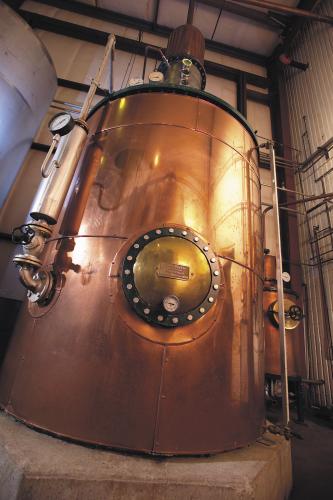
When a vendor or master distiller comes in to taste me on their whisky, I always here them talk about the how the copper still really makes a difference, but when I ask them specifically why, they say something vague like, "the shape makes a difference in the flavor" or "it enhances the spirit."  WTF?  That doesn't help me understand the distillation process as someone who is trying to get a grip on this whole artisan whisky thing.  However, having finally secured a copy of Andrew Jefford's Peat Smoke & Spirit, is was clearly spelled out for me in a way that I think everyone can understand (which is why I am going to quote it on this blog). 

The basic function of copper is to help filter out the impurities in the whisky.  While alcohol boils at 78.5 degrees, so do a bunch of other other chemicals, such as Methanol, which will make you blind if you drink too much of it.  Great distillers are able to capture the purest of spirits in their still and the "fine, microscopic hairiness of copper, and its sociable, reactive nature...makes it such an ideal distilling material."  Douglas Murray is quoted as saying, "If you look at copper under a microscope it looks like a scouring pad.  The result is that, as the spirit vapour passes over it, copper stops that vapor for what we call a 'chat.' The more slowly the vapour passes over the copper, the more the chemical impurities in the spirit attach themselves to the fine scouring-pad threads.  The longer the chat does on, in other words, the lighter the spirit." 

This also explains why the shape of the lyne arm - the neck of the still where the vapor collects - is also so influential.  The length and width of the lyne determine the amount of contact the condensing spirit has with the copper!

That makes total sense to me.  I now understand why copper stills are important.

-David Driscoll

Reader Comments (1)

Well in fact the copper doesn't remove methanol, which is present in the final product of whisk(e)ys, brandies and rum (among others) in quite high concentrations. Only rectification (distillation) to a high degree using fractional or column stills can separate methanol effectively from the ethanol since they are so similar in boiling points and properties. However luckily ethanol acts as an antidote to methanol poisoning (they even use it in medicine for this) by blocking its decomposition into toxic metabolites by using the same enzymes to break it down when its in a much higher concentration. Luckily too the aging process used with spirits (and even non distilled wine and beer) allows the methanol and other alcohols (knwon as fusel oils) to react in the slighlty acid conditons over time to form delicious tasty esters - at the same time reducing the acidity a little too.
Getting back to the issue of copper - it is used because it is very good at scavenging/reacting-with traces of sulfurous compounds (hydrogen sulfide, sulfur oxides etc.) which are notorious for producing off notes in spirits. Remeber tiny traces of organic sulfur compounds are used to taint odorless natural gas, LPG, LNG, butane gases etc for safety giving an unpleasent smell at very low conc's.

April 18, 2013 | Unregistered Commentera little informed

PostPost a New Comment

Enter your information below to add a new comment.

My response is on my own website »
Author Email (optional):
Author URL (optional):
Post:
 
Some HTML allowed: <a href="" title=""> <abbr title=""> <acronym title=""> <b> <blockquote cite=""> <code> <em> <i> <strike> <strong>